A rehearsed interview answer still needs a follow-up
The opening answer is only the opening
A candidate describes a difficult launch. They aligned stakeholders, mitigated risk and protected customer trust. The answer has a tidy beginning, middle and end. Perhaps AI helped them prepare. Perhaps they rehearsed it with a friend.
You do not yet know which decision was theirs. Ask that question before guessing how the answer was written.
Interview preparation and live assistance are different conditions. Explain the format, permitted notes and any restrictions on live tools before the call. A rule introduced because one answer sounds fluent arrives too late to guide preparation.
Ask for a decision, then find the details
For an operations manager opening, use this illustrative question:
“Tell us about a commitment you had to change when new information arrived. What did you decide, and how did you handle the people affected?”
OPM describes structured interviews using predetermined questions and common rating standards for job-related competencies. Prepare relevant clarification prompts as well, so one candidate does not get coaching while another gets a cross-examination.[opm-interviews]
- What could you decide without approval?
- Which information changed your view, and how did you check it?
- What alternative did you reject?
- What did you communicate, to whom and when?
- What happened afterwards?
Use the prompts when the answer leaves those points unclear. Allow an anonymised or different example if the first would expose confidential information. Record which prompts were needed.
Here is the conversation worth having
The candidates and launch below are invented. Inez begins with the polished account above. The interviewer follows the decision:
Scroll sideways to read the full table.
| Speaker | What they say |
|---|---|
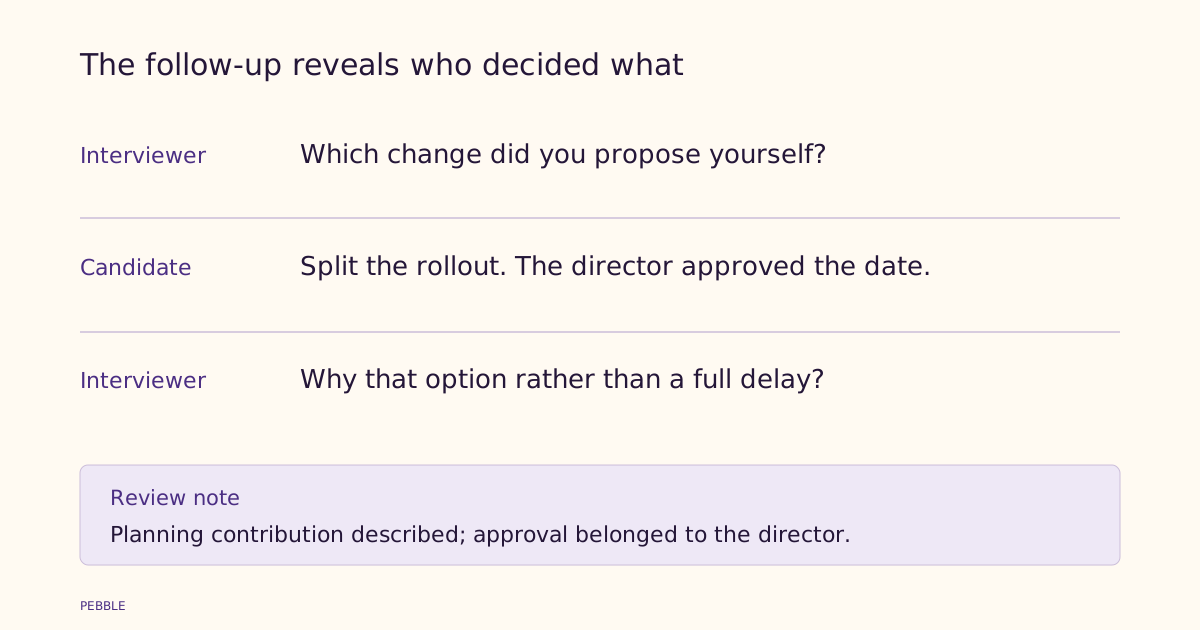
| Interviewer | Which change did you propose yourself? |
| Inez | Split the rollout into two groups. The director approved the revised date. |
| Interviewer | Why that option rather than a full delay? |
| Inez | The smaller group fit our support capacity. A full delay would leave every customer waiting. |
| Interviewer | What did you get wrong? |
| Inez | I underestimated support demand from the first group; we adjusted the second rollout. |
Now the reviewer can describe a planning contribution, an approval boundary and an assumption that needed correction. Do not promote “proposed the plan” into sole authority for the launch.
Tomas gives an equally polished opening but cannot identify what information changed the plan after the agreed prompts. Note that decision reasoning remains unclear. Do not label the answer AI-generated. Offer a simpler or adjacent example consistently if it could answer the same criterion.
Change one fact for everyone
“The supplier can now meet the original date, but support capacity has halved. What would you check before changing your recommendation?”
If adapting plans matters to the job, this shared hypothetical can reveal how the candidate thinks beyond the prepared story. Give thinking time and the same facts. Say in advance that the interview includes a hypothetical; withholding a crucial detail just to create surprise adds little.
The useful record is the check the candidate proposed, the alternative they considered and what remains unanswered.
Write observations before impressions
Scroll sideways to read the full table.
| Criterion | Record |
|---|---|
| Responsibility | Personal decision and approval needed |
| Information | Inputs used and how they were checked |
| Trade-offs | An alternative and its consequences |
| Communication | Who needed to know, what and when |
| Reflection | Difference between the expected and actual outcome |
Write the observations before an overall recommendation. Verbal fluency, eye contact and a familiar career story should not substitute for operational judgement. If communication is itself a requirement, define the work-related standard and assess it deliberately.
A prepared answer can contain real experience. An unrehearsed answer can remain vague. The follow-up should let you tell what the candidate explained, what you had to prompt and what the next reviewer still needs to ask.
Sources and further reading
- OPM: Structured InterviewsReviewed October 4, 2026
“Human reviewed” should mean somebody checked the application
Read article
If candidates can use AI, make the exercise test their judgement
Read article