Your job description is ready. Your screening criteria probably aren't.
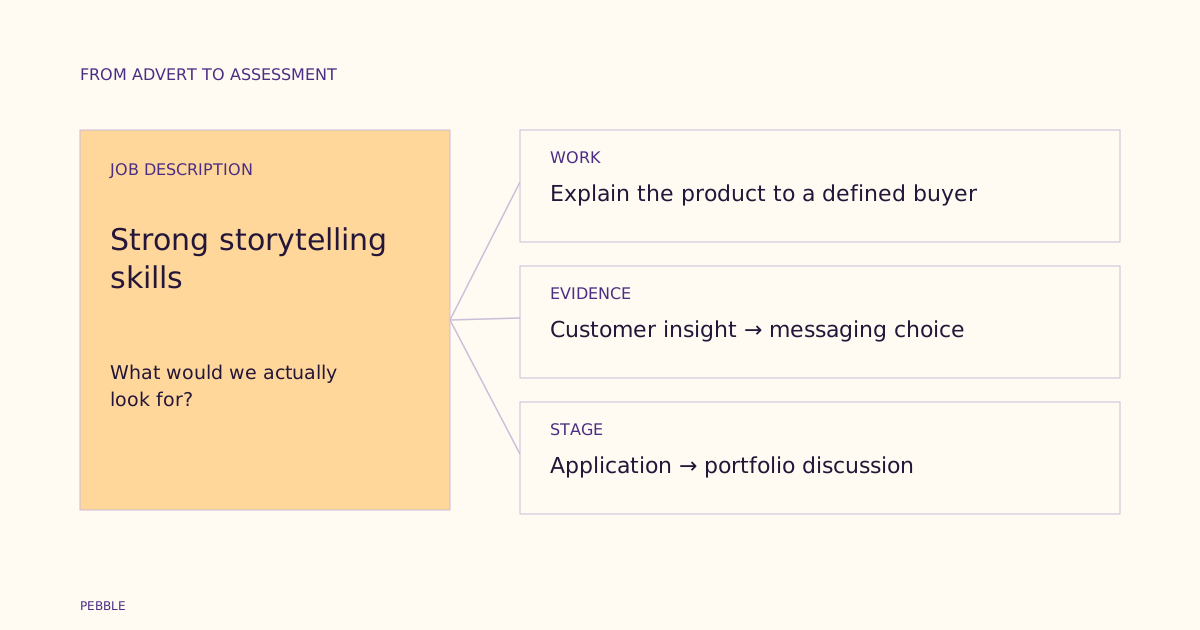
Job description
Strong storytelling skillsWork
Explain the product to a defined buyerEvidence
Customer insight → messaging choiceStage
Application → portfolio discussionThe question to start with
You approve the job description, publish it, and start opening applications. Then someone on the team asks a surprisingly difficult question: “Would we interview someone who has never held this exact title?”
The document says “proven experience”, “strong communication”, and “comfortable in a fast-paced environment”. It gives you plenty of things to like. It gives you very little help with that decision.
Before applications arrive, get the team together and turn each important requirement into evidence you can assess. That conversation often reveals a disagreement the job description has hidden.
This article follows a hypothetical software startup hiring its first product marketer. The founder wants clearer positioning, a more coherent launch process, and sales material that answers real buyer questions. The role, requirements, and examples are fictional. You can replace them with your own in the worksheet below.
First, find the unresolved job
The initial description asks for someone who can own strategy, write copy, build campaigns, support sales, analyse performance, manage agencies, and lead launches.
That could describe several jobs. The screening problem begins here: reviewers may each choose a different centre of gravity. The founder prefers a strategic storyteller. Sales wants usable collateral. The product lead wants someone who can run launches without daily supervision.
Get those people together and ask: “Which three pieces of work would make us glad we hired this person six months from now?”
For the fictional company, the answer becomes:
- Turn customer and sales conversations into positioning the team can use
- Plan and deliver a product launch with the product and sales teams
- Create and revise sales material around recurring buyer questions
Write down what will not belong to this role yet. If paid acquisition sits with an agency, deep channel-buying experience may be useful, but it should not dominate screening for the person doing this work.
OPM's job-analysis guidance connects job tasks to the competencies needed to perform them. That is a sound starting point for this exercise. The worksheet is an editorial template, not a professionally validated selection method.
Translate one line at a time
Every requirement needs three answers: what work it supports, what evidence you will accept, and when you can reasonably assess it.
Scroll sideways to read the full table.
| Line in the draft JD | Work behind it | Screening criterion | Where to assess it |
|---|---|---|---|
| Strong storytelling skills | Explain the product in terms buyers understand | Can describe translating customer insight into messaging | Application example, then portfolio discussion |
| Experience leading launches | Coordinate a release across functions | Has owned identifiable parts of a launch, including dependencies and decisions | CV or application, then structured interview |
| Excellent communication | Make useful sales material and handle competing input | Can explain a message choice and how feedback changed it | Work discussion or short, relevant exercise |
| B2B SaaS background | Understand a multi-person buying process | Has worked with a comparable buying process or can explain relevant adjacent experience | Application and interview |
| Comfortable with ambiguity | Make progress when requirements are incomplete | Can describe an uncertain brief, assumptions made, and checks used | Structured interview |
Notice how much moves out of CV screening. A CV can mention positioning work. It will rarely show whether the message was clear or whether the candidate reached it through sensible research.
Trying to settle every criterion at the application stage encourages reviewers to fill in the blanks themselves. Decide which blanks you will investigate later.
Make the “must-have” column earn its place
For each supposed requirement, ask what would happen if a capable candidate lacked it on their first day.
If the answer is “we would need to teach them our analytics tool”, consider whether that is manageable. If the answer is “nobody else can do the customer research, and the launch depends on it”, the underlying research capability deserves more weight.
Treat years of experience the same way. What are you hoping those years represent? Independent ownership? Several launch cycles? Familiarity with a complex buying committee? Name that evidence directly. Years alone do not tell you which work someone did or how much responsibility they held.
In this example, previous use of the company's preferred CRM becomes a learnable preference. Experience making and defending messaging decisions remains central. A particular previous job title is removed from the screening gate.
Do not remove genuine professional qualifications or other necessary requirements just to make a shorter list. Establish why each is needed and how you will verify it. The aim is a defensible connection to the work.
The worksheet to complete before you screen
Use one row per criterion. If you cannot complete a row, the requirement needs another conversation.
Scroll sideways to read the full table.
| Field | Worked example for the hypothetical product marketer |
|---|---|
| Outcome this supports | Give sales a clear explanation of the product for a defined buyer |
| Criterion | Turns customer evidence into messaging choices |
| Acceptable early evidence | A described project showing the audience, research input, personal contribution, and messaging decision |
| Equivalent evidence | Comparable work under a different title, or in an adjacent industry with a similar buying process |
| Insufficient evidence on its own | “Strategic storyteller”; a recognised employer; a portfolio headline without context |
| Unknown policy | Keep as an open question when the application provides too little detail |
| Next-stage question | Tell us about a message you changed after hearing from customers. What changed your mind? |
| Stronger-answer anchor | Explains the input, choice, trade-off, personal role, and how the team checked the result |
| Reviewer and version | Named hiring manager; criteria version and date |
An answer anchor helps reviewers know what they are listening for. Avoid writing one so narrowly that only your preferred career path can satisfy it. The details should concern the work, not the prestige of the setting.
For later interviews, OPM describes a structured approach using common questions and rating standards. Keep your core questions consistent, while allowing relevant clarification and appropriate accommodations.
Now test the awkward application
Imagine a fictional applicant, Alex, whose title is “Content Lead”. Their CV describes interviewing customers, rewriting product pages after research, and helping sales explain a complicated feature. It says little about launch planning.
Under the original JD, Alex may disappear because the title looks wrong. Under the worksheet, there is relevant evidence for customer-informed messaging and an open question about launch ownership.
The sensible next step depends on the role's agreed priorities. If launches are the immediate bottleneck, ask for a specific launch example before a full interview. If messaging is the urgent work and launch coordination can be supported, a conversation may already be worthwhile.
Make that trade-off before you meet Alex. Changing it because you like a particular application gives the rest of the pool a moving target.
A completed worksheet may also reveal that the job description needs an edit. Perhaps the advertised role promises strategic ownership while the scorecard rewards production speed. Fix that mismatch before asking candidates to invest more time.
You are ready to screen when the team can explain the important work, recognise more than one credible route to doing it and agree on what remains to be tested. Keep the completed worksheet beside the application. If a reviewer cannot connect a claim to one of those rows, ask what they are actually assessing.
Sources and further reading
- OPM: Job AnalysisReviewed October 2, 2026
- OPM: Structured InterviewsReviewed October 2, 2026
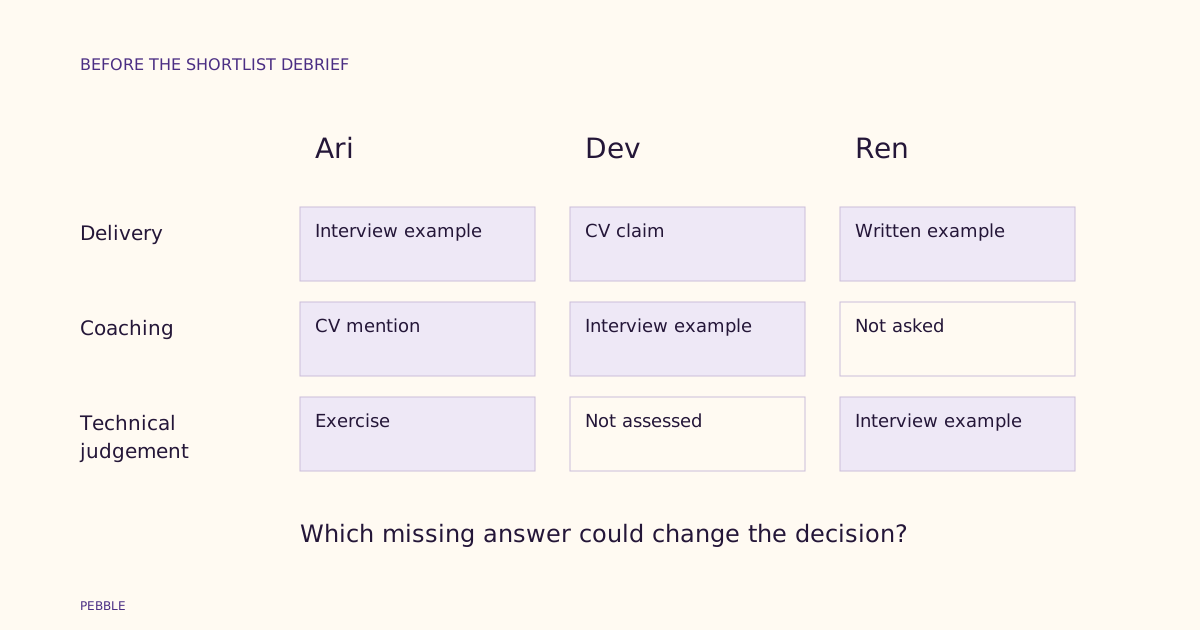
How to compare a shortlist when the evidence is uneven
Read article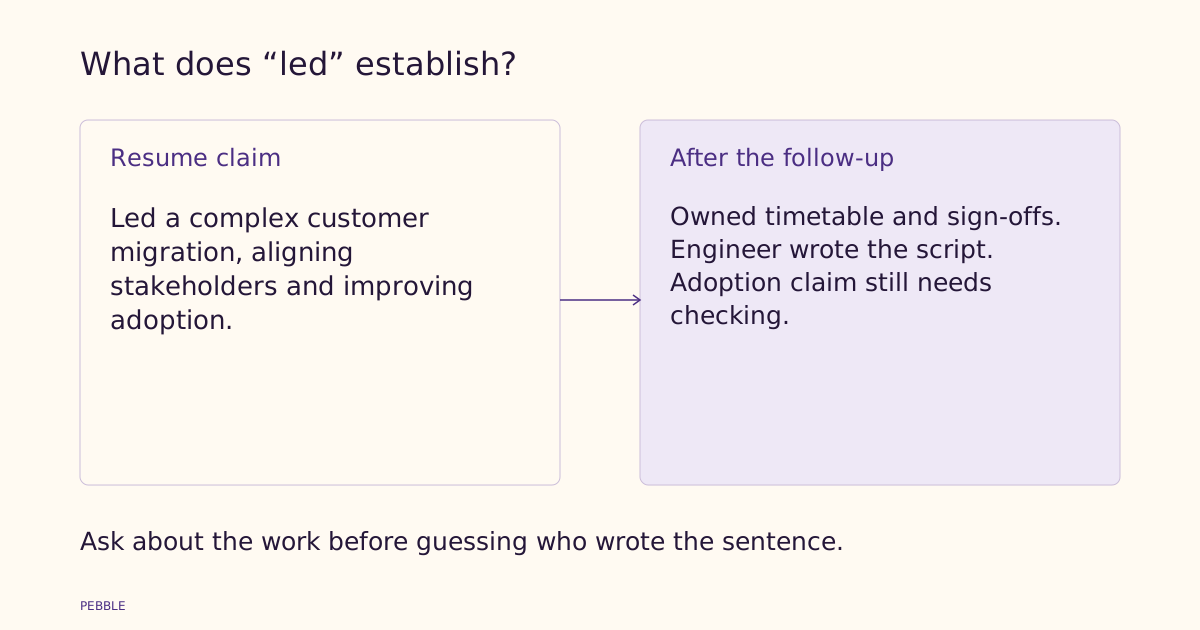
The resume sounds impressive. What did the candidate actually do?
Read article