Try AI screening on one opening before you roll it out
Choose a task you can inspect
A convincing demo can leave the hardest question unanswered: what happens when your reviewers use the assessment on your applications? Start with one opening and a task small enough to check.
For the example below, a software company needs a support operations lead. Its requirements are settled: handle escalations, maintain service reporting and coordinate recurring problems with product. The pilot looks for resume evidence of those tasks. It does not assess interview performance or recommend pay. The company and plan are illustrative.
NIST connects intended use, testing under deployment-like conditions, monitoring and the ability to disengage a system. Those principles support a controlled pilot. They do not make a small operational trial a complete validation programme.[nist-core]
Name the decision date before starting. Otherwise a pilot can become normal operation while the team is still saying it is an experiment.
A pilot brief the team can actually use
Scroll sideways to read the full table.
| Decision | Plan |
|---|---|
| Scope | Resume evidence for the settled support-lead criteria |
| People | Hiring manager owns the pilot; recruiter checks inputs; second reviewer resolves disagreements |
| Data | Approved documents, language scope and processing route |
| Outside scope | Use the established human process |
| Pause owner | A named person who can stop use and return affected applications to human review |
| Review date | Set before the first run; choose the next scope using the findings |
Confirm the input route with the data owner. Tell reviewers what the assessment can and cannot be used for. A candidate outside the pilot’s document or language scope should not receive an improvised process.
Leave room for the pilot to end with the manual workflow. The purpose is to decide whether this use helps, not to manufacture evidence for a rollout already promised.
Read the application before seeing the model’s answer
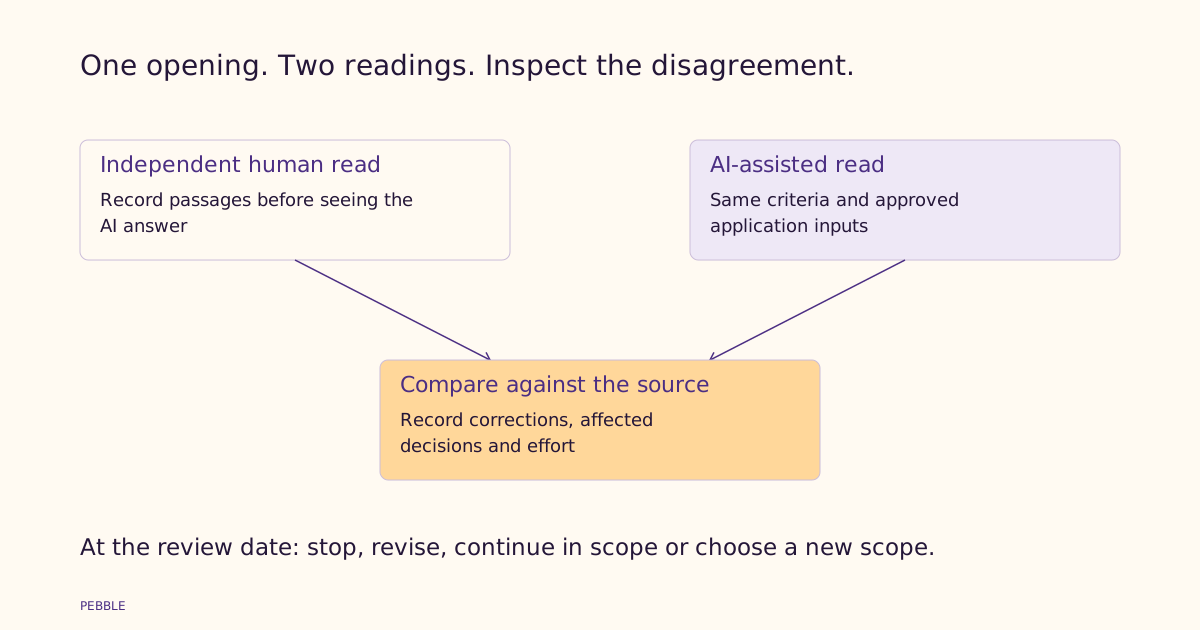
Have a reviewer examine the original against the criteria, record relevant passages and note the proposed next step. Then reveal the AI assessment and compare. If the reviewer sees the model’s phrasing first, the supposedly independent baseline can become another version of it.
The reviewer can be wrong too. Resolve a disagreement using the source and criteria. A missed passage, ambiguous requirement and unsupported model claim are different findings. Agreement with a reviewer does not prove future job performance.
If the unresolved question moves to interview, keep a common assessment basis. OPM describes structured interviews with common questions and rating standards; that guidance does not validate the earlier AI screen.[opm-interviews]
Count corrections, including the work they create
Scroll sideways to read the full table.
| Observation | What to record |
|---|---|
| Unsupported conclusion | The claim, source passage and next decision affected |
| Missed evidence | The passage that should have been considered |
| Reading failure | Missing page, parsing problem or wrong-record attachment |
| Reviewer effort | Reading, checking, discussion and repairs |
| Coverage gap | Formats, languages or cases not adequately examined |
Keep the denominator visible: how many applications were actually reviewed? An incomplete run is not a successful assessment. Describe the cases behind a summary so a serious failure in one format does not disappear inside an overall result.
Time saved in the first read may reappear as correction work later. A small sample may miss uncommon languages, career paths or difficult scans. Write down those limits. Broader evaluation may need specialist and statistical expertise.
Decide what makes you stop
Choose pause triggers before the first assessment. Examples to investigate include invented evidence affecting a recommendation, missing pages, output attached to the wrong person or a reviewer unable to inspect the cited source.
When use pauses, identify affected applications, return them to the approved human process and correct misleading summaries in later stages. Stopping new runs does not repair old output.
At the review date, choose to stop, revise, continue in the same scope or expand to a named new scope. State what the evidence supports and what remains untested. New roles, languages, formats, criteria or processing configurations need another decision.
A support-role pilot tells you about that task under those conditions. It is a starting point for the next question, not permission to use the tool everywhere.
Sources and further reading
- NIST AI Risk Management Framework 1.0: CoreReviewed October 4, 2026
- OPM: Structured InterviewsReviewed October 4, 2026
“Human reviewed” should mean somebody checked the application
Read article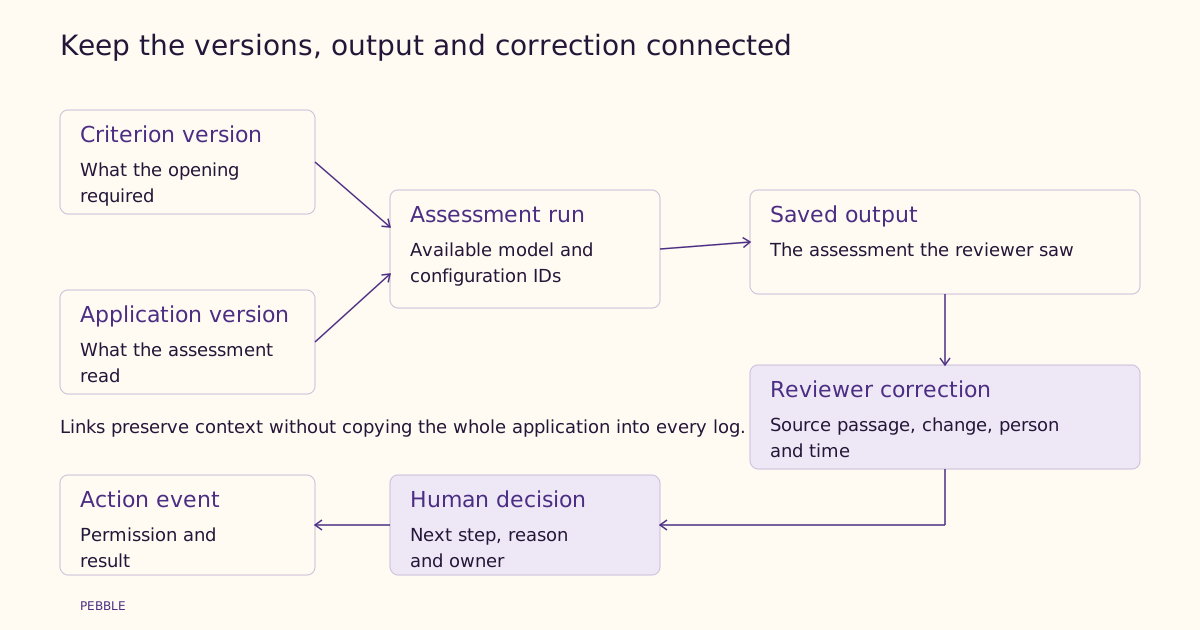
Save the assessment the reviewer saw, and the correction they made
Read article