A translated job title can change the whole assessment
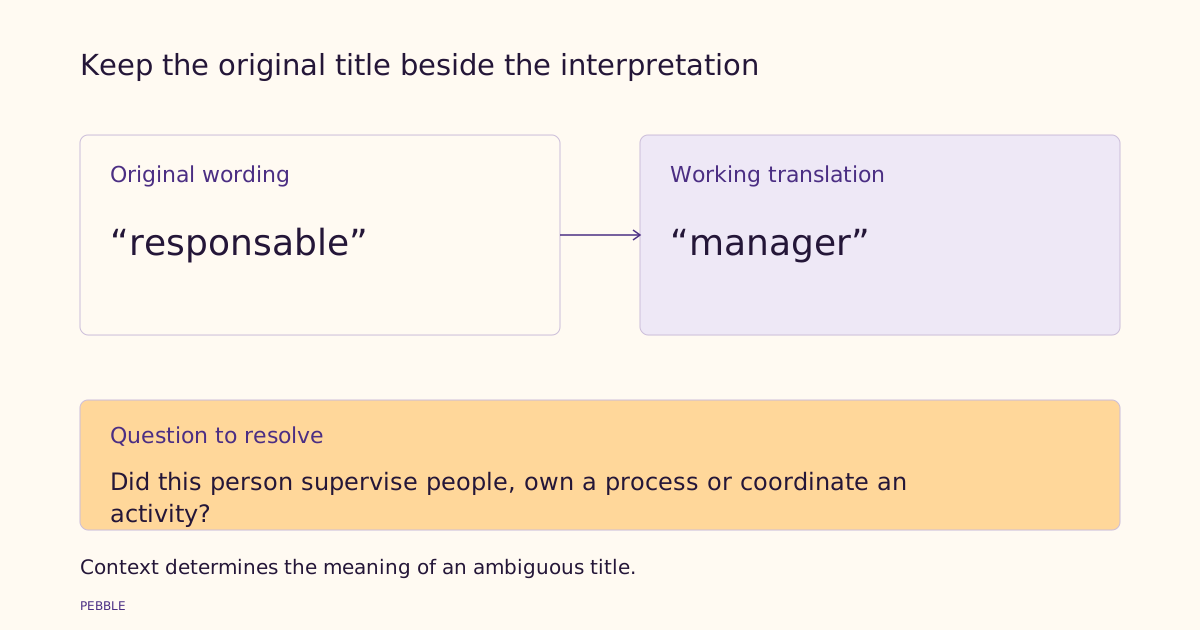
Does “manager” mean somebody managed people?
A procurement coordinator’s resume arrives in French. A working English translation turns a title containing “responsable” into “manager”. The reviewer starts looking for people-management experience.
The title alone does not establish that responsibility. In this invented example, the passage describes supplier follow-up. Check whether the person supervised people, owned a process or coordinated an activity. This is not a universal translation rule for the French term.
Scroll sideways to read the full table.
| Version | Text |
|---|---|
| French source | Responsable du suivi fournisseurs. Je suivais les livraisons des fournisseurs et signalais les retards au responsable des achats. |
| Working English translation to review | Supplier follow-up manager. I tracked supplier deliveries and reported delays to the purchasing manager. |
| Context-preserving English wording | Responsible for supplier follow-up. I tracked supplier deliveries and reported delays to the person responsible for purchasing. |
| Corrected assessment note | The passage describes tracking deliveries and reporting delays. It does not state whether the applicant supervised people. Ask who made supplier decisions and whether anyone reported to them. |
Both English versions are working translations for this example. “Responsible for” keeps the title open where “manager” may suggest a formal management role. The surrounding sentence supports tracking and reporting; it does not settle the applicant’s authority. A bilingual review and a focused question can clarify that distinction.
Keep the original title beside the translation. Ask who made supplier decisions and whether anybody reported to the applicant. That answers the role question more directly than debating which English title sounds most senior.
Keep the original, extracted text and translation distinct
First check that extraction read the document correctly. Then check the translation. Only then assess the claim against the opening’s requirements. A table or column error can attach a sentence to the wrong role before translation even starts.
Scroll sideways to read the full table.
| Layer | What to inspect |
|---|---|
| Original passage | The title and the surrounding responsibility description |
| Extracted text | Whether the right sentences remain connected to the right role |
| Working translation | Whether “manager” added an unsupported responsibility |
| Review note | Supplier coordination described; people-management responsibility needs clarification |
A fluent translation can still lose a negative, change a date range or overstate ownership. Read the words that would change the next decision. Keep uncertainty in the note until somebody can resolve it.
Preserve the terms that carry the meaning
Keep employer, product and qualification names traceable to the original. Show a translated label alongside the source term when it helps. Do not silently convert a qualification into a local equivalent; verify an equivalence through an appropriate authoritative process.
Google’s glossary documentation describes controls for domain-specific terms and named entities. Microsoft documents ways to exclude content from translation, including HTML-only tagging methods. These are available translation controls, not guarantees of resume accuracy or claims about Pebble features.[google-glossary][microsoft-preserve]
For recurring terms in your roles, keep a small reviewed record: source wording, interpretation, context, reviewer and date. A glossary can make terminology consistent. It cannot tell you whether this particular candidate owned the work.
Ask for help on the sentence that matters
When a central passage is ambiguous and the team cannot verify it, use a qualified bilingual reviewer or translation professional. Supply the source and job context through an approved data-sharing route. Ask what is ambiguous, not just for a smoother English sentence.
Another machine translation or a back-translation can expose a disagreement. Agreement between outputs is not independent proof that the original was understood. If the team still cannot resolve the passage, choose a focused clarification or appropriate human review.
Do not infer ability from nationality, a name or the language of the application. Nor should awkward English in a working translation become evidence that the person cannot coordinate suppliers. That is the translation service’s output, not an observed work sample.
Return to the work the opening needs
For this coordinator opening, the questions concern tracking dependencies and handling changed supplier requirements. Keep those criteria steady while clarifying the wording. If language proficiency is itself needed, define it separately and assess it through a job-related method.
OPM’s structured-interview guidance describes common questions and rating standards. Use consistent core work questions when clarifying translated claims, with appropriate interpretation or other process support.[opm-interviews]
There is no basis here to assume equal AI screening quality across languages. Check the actual language pairs, documents and review expertise in your process. The corrected note should preserve what the passage supports and name the question the translation could not settle.
Sources and further reading
- Google Cloud Translation: Creating and Using GlossariesReviewed October 4, 2026
- Microsoft Azure Translator: Prevent Content TranslationReviewed October 4, 2026
- OPM: Structured InterviewsReviewed October 4, 2026
“Human reviewed” should mean somebody checked the application
Read article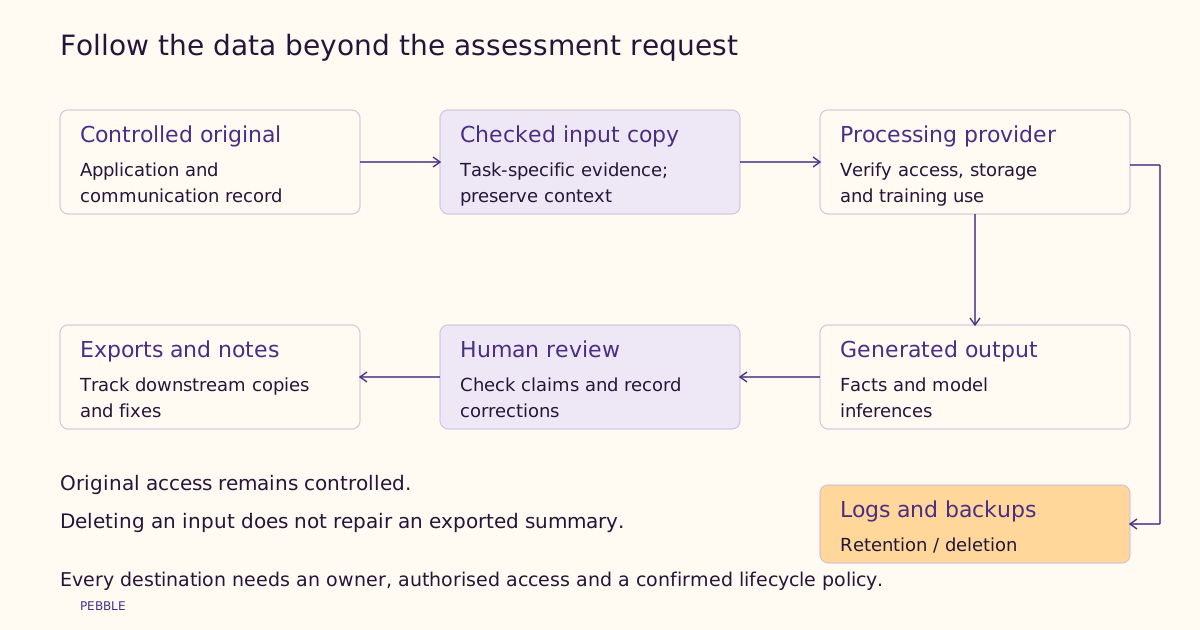
The screening task needs the project example. Does it need the whole file?
Read article